WWEA Half-year Report 2026: Global Wind Power Growth Slows Down
WWEA Half-year Report 2026
Global Wind Power Growth Slows Down, Stronger Momentum Expected in H2 2026
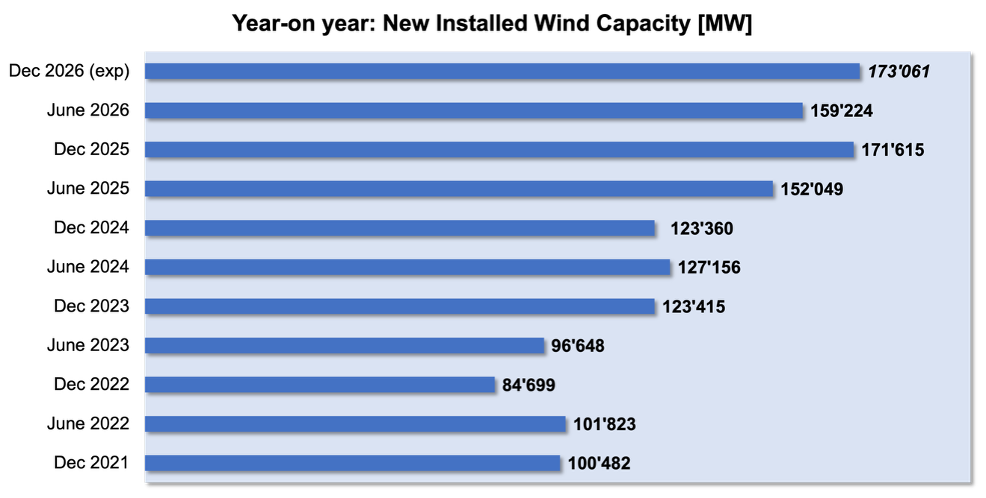
Wind power deployment worldwide slowed down substantially in the first half of the year 2026, with new installations reaching 59 GW, substantially less than the 71 GW of 2025. On an annual basis, over the twelve months from July 2025 to June 2026, new installations reached 159 GW, compared to 152 GW in the previous period. This reflects the still strong momentum of the wind industry worldwide.
Accordingly, due to various factors and based on expectations of our members, it is expected that wind power deployment will again accelerate in the second half of 2026 so that total installations will reach a level similar to that of 2025, 173 GW.
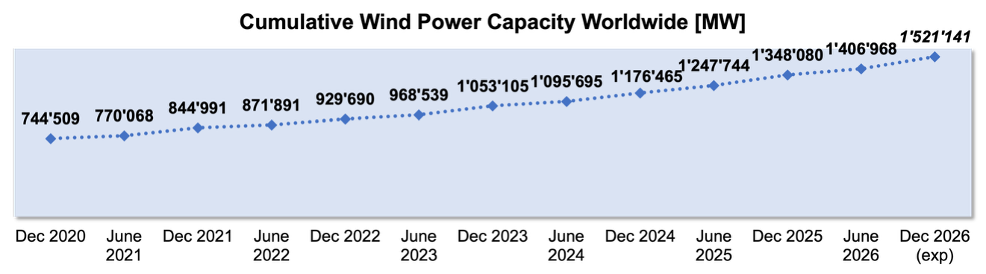
The current global wind capacity has reached 1407 GW and is expected to reach 1521 GW by end of this year. In the year 2030, an overall capacity of at least 2250 GW is expected.
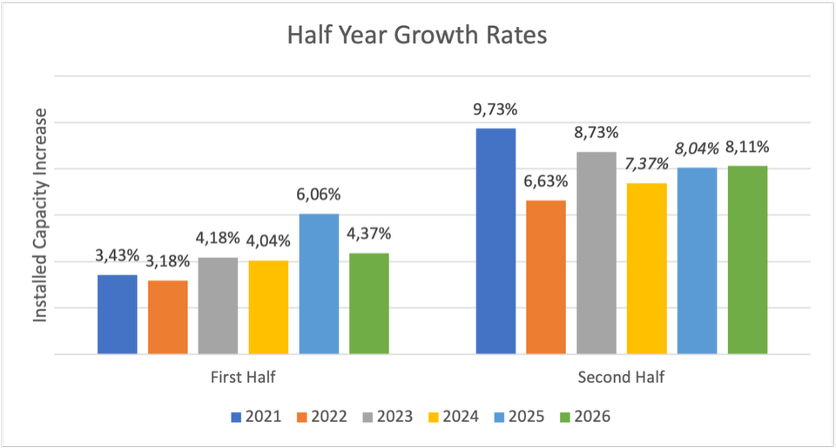
The global growth rate in the first half of 2026 was 4,37%, after 6,06% a year ago. On an annual basis, the growth rate was at 12,76%, less than the 13,88% of the previous year. Throughout the whole year 2026, a growth rate of 12,84% is expected, less than 14,59% of the year 2025.
Highlights
|
· 58,9 GW added in the first half of 2026, down 18% year-on-year · 159 GW installed between July 2025 and June 2026 · Global total: 1’407 GW (1,407 TW) as of June 2026 · Annual growth rate: 12,76% · Wind power share: ~12% of global electricity supply · China: 38,7 GW added, 25% less than in the previous year · US and Germany show strong momentum, Brazil, France and UK slump · Full-year 2026 outlook: around 173 GW new installations expected · Projected total by the end of 2026: over 1’521 GW · Projected total by the end of 2030: more than 2’250 GW
|
Global Developments
The World Wind Energy Association (WWEA) has compiled statistics on global wind power installations for the first half of 2026, based on data and forecasts from national associations, official statistics, and WWEA estimates. The figures reflect both confirmed installations and projections for the remainder of the year.
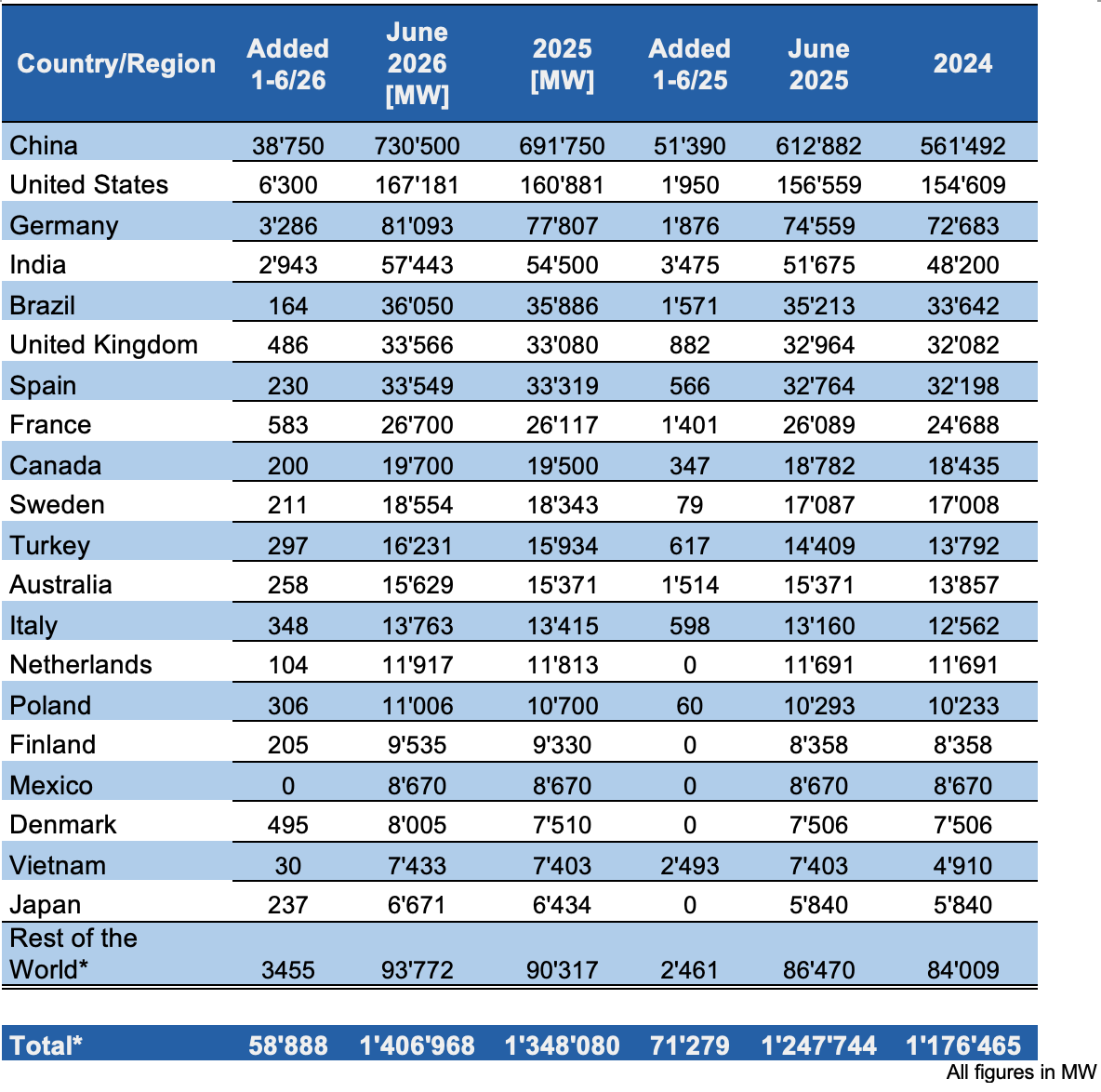
In the first six months of 2026, the world added 58’888 MW of new capacity — 18% less than the 71’279 MW installed during the same period of 2025, but still well above the levels of previous years (42,6 GW in H1 2024, 38,8 GW in H1 2023 and 26,9 GW in H1 2022). This corresponds to an increase of 159 GW in total installed capacity compared with June 2025, from 1’096 GW in June 2024, 1’248 GW in June 2025 to 1’407 GW in June 2026.
The semiannual growth rate reached 4,4%, compared with 6,1% in the first half of 2025, 4,0% in 2024 and 4,2% in 2023. This growth rate is typically lower than the expected growth rate for the second half of the year, when more than 8% growth is again expected. Throughout the whole year 2026, the growth of 12,8% is expected, after 14,6% in 2025.
Market Dynamics and Outlook
After a very strong year 2025, the year 2026 started with lower momentum, however robust growth. It is expected that growth will again become stronger in the second half of the year, as the wind industry can use its existing capacities.
Growing uncertainties in some countries may rather result in more installations this year, as investors rush to benefit from existing frameworks. This may, however, have a slightly negative medium-term impact.
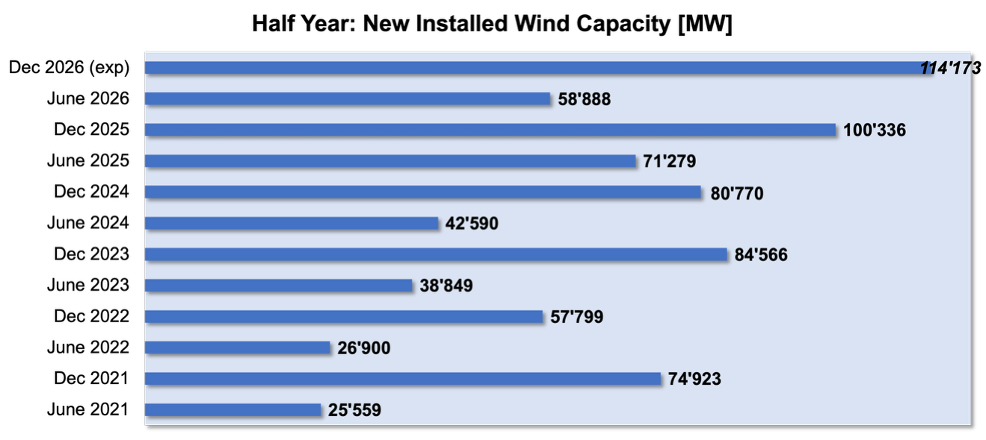
For various reasons, the global wind markets are expected to regain momentum in the second half of 2026 and accelerated expansion is expected. According to WWEA member estimates, total new installations for the full year are likely to reach over 173 GW – slightly more than in 2025. This exceeds the 123 GW added in 2024, 123 GW in 2023, and 85 GW in 2022.
By the end of 2026, global cumulative wind capacity is projected to exceed 1’521 GW, sufficient to generate around 12% of the world’s electricity.
Mid-term prospects appear rather stable: WWEA members expect a global installed capacity of at least 2’250 GW by 2030. This would mean a rather stable annual growth from the current 173 GW to well above 180 GW.
Country Highlights
China remains by far the world’s largest wind power market. In the first half of 2026, the country installed 38,7 GW, significantly less than in 2025 when 51,4 GW were added, but still much more than in 2024 (25,8 GW) and in 2023 (23,8 GW). With a cumulative total of over 730 GW, China continues to lead global wind development by a wide margin, with 52% of the global capacity, although with a share in new installations of 66%, the dominance has decreased compared to 2025 when China stood for almost 80% of the market for new installations.
Only three other countries added more than 1 GW each in the first half of 2026, after seven in 2025: United States: 6,3 GW, Germany: 3,3 GW and India: 2,9 GW.
The US market has shown very strong momentum, more than tripling its new capacity, which lies at 6,3 GW from January to June 2026. This momentum is expected to continue until 2027, driven by legislative and regulatory changes by the current national administration which may lead in the mid-term to the collapse of the US market.
Germany is also benefitting from regulatory improvements and added a new record of 3,3 GW in the first half of 2026, almost double the 2025 additions. In light of current, mixed signals from the current government, new installations may peak in 2026 with unclear, short-term prospects.
The Indian market dropped from second to fourth position in 2026 but the country still shows the results of long-term political support and added 2,9 GW, after 3,5 GW in the first six months of 2025.
France with 583 MW, Denmark with 495 MW and the United Kingdom with 486 MW represented the only three medium-sized markets of around half Gigawatt, with France and the UK facing dramatic decreases. Ukraine, with 415 MW of new capacity, should also be mentioned here, showing remarkable resilience in light of the ongoing Russian attacks.
Brazil saw a dramatic decrease in new installations by almost 90%, dropping from 1,6 GW to only 164 MW of new capacity added in H1 2026.
Ranking Changes
There was no major change in the ranking of the top 20 markets, just in the ongoing race between the United Kingdom and Spain, the UK has been able to overtake its competitor by only 17 MW.
Conclusion
The first half of 2026 demonstrates the continued momentum and resilience of the global wind power sector. Mainly driven by four large markets, in particular continued growth in China, but also stronger momentum in the US, Germany and India, wind energy is on course to match and slightly surpass the strongest year on record, 2025. With a record 173 GW expected to be installed in 2026 and a global total surpassing 1,5 terawatts, wind power underlines its central role in the world’s renewable energy transformation.
WWEA President Dr. Irfan Mirza:
The first half of 2026 demonstrates both the resilience of the global wind energy sector and the challenges that lie ahead. While new installations have slowed compared with the exceptional growth of 2025, global wind capacity has surpassed 1’400 GW, reaffirming wind energy's increasingly important role in the global energy transformation.
However, the geographical concentration of wind power development remains a matter of concern. A few leading markets continue to account for the overwhelming majority of new installations, while many countries with significant wind resources are yet to realize their potential. Accelerating deployment in emerging markets must therefore become a global priority, supported by stable policy frameworks, accessible financing, technology transfer, and institutional capacity building.
Equally important is the need to strengthen international and regional cooperation. Greater regional grid interconnections can facilitate renewable energy integration and improve energy security, while cooperation in manufacturing, supply chains, technical expertise, and infrastructure development can create new opportunities for countries at different stages of their energy transition.
At WWEA, we believe that the success of wind energy must also be measured by the benefits it delivers to people and communities. Meaningful community engagement, local economic participation, and equitable benefit-sharing are essential for sustainable and inclusive growth. WWEA's Community Engagement Guidelines provide an important foundation for advancing these objectives.
Looking ahead, the World Wind Energy Conference 2027 in Oman will offer an important platform to strengthen international partnerships, highlight opportunities in emerging wind markets, and promote regional cooperation, particularly across the Middle East and beyond.
WWEA remains committed to bringing together governments, industry, investors, researchers, and communities to accelerate a truly global energy transformation. Our collective challenge is not simply to install more wind capacity, but to ensure that its growth is geographically balanced, economically sustainable, and beneficial to societies worldwide.
WWEA Secretary General Stefan Gsänger:
In the first half of 2026, four countries are showing the world how fast wind power can be deployed: China as the permanent driver, the USA despite strong efforts by the current administration to slow wind power growth, Germany as the world's third-largest economy, and India as the most populous country on Earth. These nations – and their people and businesses – are an inspiration for the rest of the world.
It is equally encouraging that smaller and medium-sized countries, some of them long ago, have also set out on the path to a renewable energy future – from early pioneers such as Denmark to new pioneers such as Oman, host of WWEC2027. These countries are proving that wind power, as an essential part of a renewable energy supply system, is an excellent choice for energy security: no war, no trade war can interrupt the supply of the wind.
The acceleration has been remarkable. When the World Wind Energy Association was founded 25 years ago, installed wind capacity stood at around 20,000 MW. Today it is about to reach 1,500,000 MW – 75 times more. People around the world have contributed to this success story, overcoming small and large challenges and designing the future. We are proud that WWEA has helped pave the way for this achievement.
The past 25 years, with all their successes and challenges, also point the way forward. Although misinformation about wind power is spreading faster and reaching more people than ever before, citizens, communities, governments and businesses have understood that domestic renewables make them – and their countries – more resilient. Sharing the benefits broadly is therefore a key tool for continuing this success story.
We are also witnessing an amazing boom of solar power in many parts of the world. Against this background, adding wind power is a smart choice: wind and solar are excellent complementary sources, and together with storage and other options they can provide energy round the clock, all year round.
As the world moves towards a fully renewable energy supply, electrification will become another driving force of the global energy transformation. Electrification is not an end in itself – its value lies in enabling the world to use more renewable energy, and thus to become more prosperous and more resilient.
Together, we can achieve a better world based on domestic renewable energy.