Hamburg Declaration: Accelerating Global Wind Power
Hamburg Declaration:
Accelerating Global Wind Power
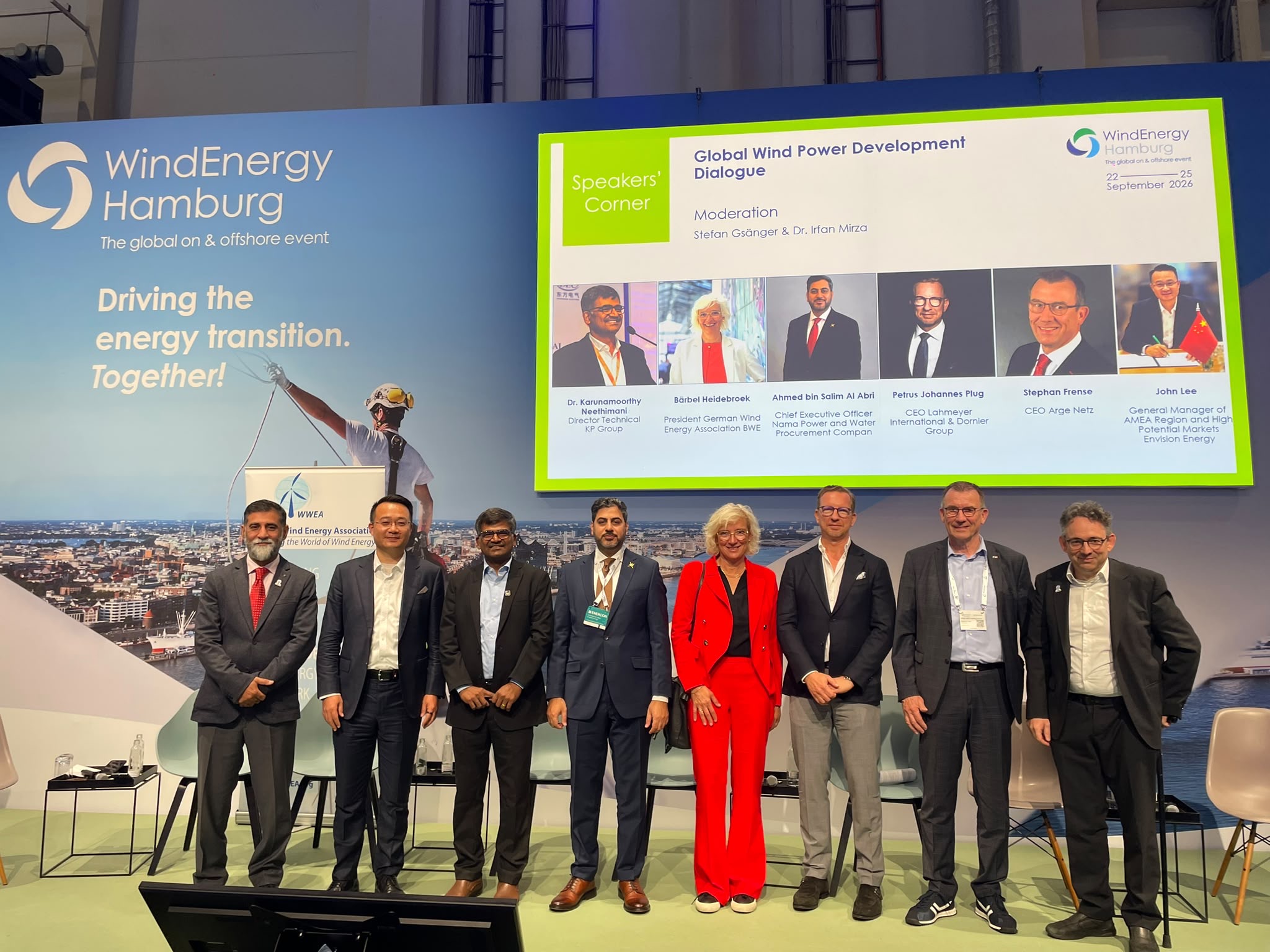
Participants of the Global Wind Power Development Dialogue 2026 – Foto: Kanin Silpa-Archa
Summarising the key points of the Global Wind Power Development Dialogue, held during WindEnergy Hamburg, 24 September 2026:
Representatives of the global wind energy community agreed on the need to scale global wind installations to 10 million MW by 2050 – requiring at least the doubling of annual wind installations – through collective action. To achieve this, there is an urgency for:
- Streamlined Permitting & Grid Expansion: Fast-track approvals and invest in grid infrastructure with clear timelines and digitalized processes to eliminate deployment bottlenecks.
- Innovative Financing & Risk Mitigation: Develop bankable models (e.g., blended finance, guarantees) to de-risk investments in emerging markets, particularly in the Global South and Gulf regions.
- Community as Partners, Not Just Stakeholders: Shift from consultation to co-ownership, ensuring local communities benefit economically from wind projects to build social license and accelerate deployment.
- Regional Cooperation for Cross-Border Scaling: Expand interconnected grids, coordinated procurement, and knowledge-sharing platforms, whether governmental or non-governmental, to unlock regional potential.
- Smart Localization + Global Supply Chains: Balance domestic industrial growth with open, resilient global supply chains – prioritizing local value where competitive, while avoiding protectionism that raises costs.
- Repowering & Circularity: Mandate repowering-friendly policies and circular economy standards (e.g., blade recycling, turbine refurbishment) to extend asset lifetimes and reduce waste.
- Fair Market Conditions: Implement measures such as carbon border adjustments (CBAM) in a transparent and fair manner, to level the playing field for sustainable manufacturers.
- Knowledge Transfer & Capacity Building: Establish global platforms (e.g., the World Wind Energy Academy) to share best practices on policy, financing, and technology, with tailored support for emerging markets.
- Industry Collaboration Over Competition: Commit to pre-competitive collaboration on standards, R&D, and supply chain resilience to reduce costs and avoid duplication.
- Unified Advocacy for Wind as a Climate & Energy Security Priority: Align global advocacy efforts to position wind energy as a cornerstone of climate action and energy independence, ensuring proportional policy support, media attention, and public investment.
Hamburg, 24 September 2026
Dr. Irfan Mirza, WWEA President
Stefan Gsänger, WWEA Secretary General