Report from the Public Private Dialogue to the IRENA Assembly by Monica Oliphant
WWEA participated in the 15th Assembly of the International Renewable Energy Agency IRENA with a delegation comprising President Dr. Irfan Mirza, Secretary General Stefan Gsänger (chair of the Empowering People & Communities Working Group at the IRENA Coalition for Action), Vice President Monica Oliphant (member of the Coalition Steering Group), Dr. Karunamoorthy and Dr. Ibrahim Togola.

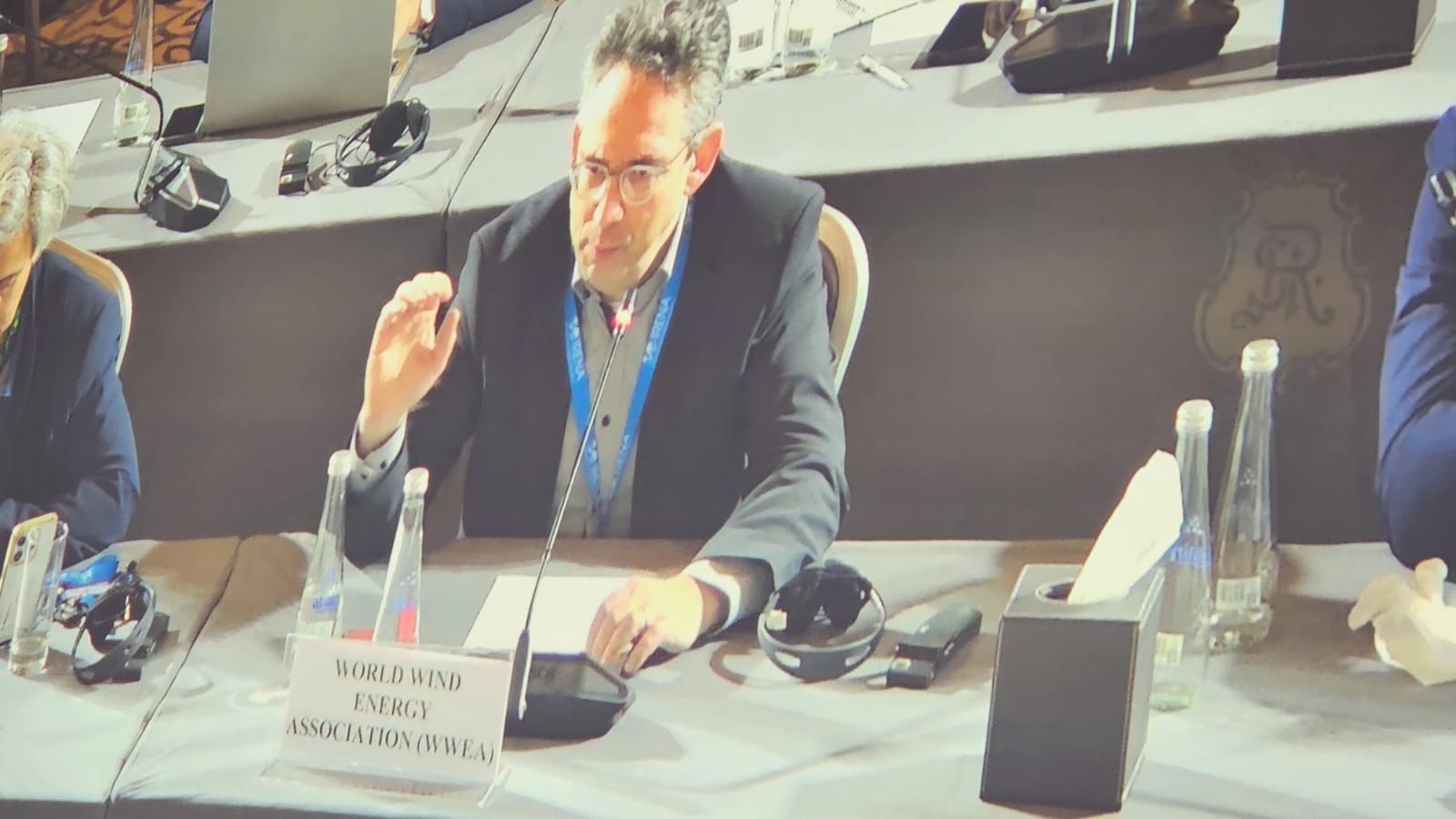
The Coalition held its main annual event about Community Support for the Energy Transition during which the coalition members as well as various governments discussed approaches and experiences. Monica Oliphant reported back to the Plenary of the Assembly:
Report back from the Public-Private Dialogue
IRENA 15th Assembly
by Ms Monica Oliphant, Vice President, World Wind Energy Association (WWEA)
on behalf of the IRENA Coalition for Action
13 January 2024
Dear President of the IRENA Assembly,
Dear IRENA Deputy Director-General,
Excellencies,
Ladies and Gentlemen,
It is my pleasure to report back from the 8th Public-Private Dialogue on behalf of the IRENA Coalition for Action.
First of all, I would like to thank IRENA and its Members for providing this opportunity through the IRENA Coalition for Action, for non-governmental actors to engage and share their views on some key issues in relation to accelerating just and inclusive energy transitions. This year the public-private dialogue focused on community support for the energy transition.
In fact, the Coalition for Action was founded back in 2014 with an objective to bolster public support for renewable energy. Since then, the membership expanded from 36 to over 170 members across the private sector, industry associations, civil society and research institutes. It became a strong global platform for key renewable energy players to share knowledge and best practices and identify actions to accelerate the energy transition.
In 2023 renewable power capacity witnessed record growth, representing 86% of the power capacity that was added in the year. However, as renewables and associated infrastructure expand, gaining public support remains more important than ever. We can already observe conflicts over land use that cause delays or even cancellations of renewable energy projects. Policies and settings perceived to be unfair can cause opposition and unrest.
It is increasingly recognised that social aspects must be put at the core of the energy transition beyond mere technological and cost debate. During the dialogue, the stakeholders unanimously agreed that the energy transition will only be successful with active citizen participation.
Many stressed the prevalence of disinformation and misinformation in the media and the need to show the tangible benefits of renewable energy through positive experience in the daily life. An impressive number of benefits of good community engagement and ownership was presented. This included a substantial German survey that showed the consistent public acceptance of renewables. China presented the co-benefits for farmers, animals and solar or wind farm developers in agri-renewable initiatives. And then there was the presentation by Uruguay, currently with a 99% renewables penetration in its electricity mix and looking to hydrogen production for new economic opportunities and decarbonising its energy sector.
I would now like to highlight four key points that form the foundation of community support emerging from this Public-Private Dialogue:
· The energy transition is an opportunity to deliver benefits for all people, rendering our energy systems more sustainable and equitable. Participants highlighted how renewable energy deployment can lower energy bills, stimulate local economic development and employment opportunities and improve public health.
· Community energy, ownership and active participation in decision-making can unlock multiple benefits in addition to building acceptance and alignment with local values and needs. In particular, it is a powerful tool for connecting remote and off-grid communities improving livelihoods of often the most vulnerable households, and respecting traditional and cultural values.
· Providing appropriate benefits can enhance support for large renewable energy projects and associated infrastructure. Participants shared examples on how renewable energy and grid infrastructure projects can gain social licence by ownership, benefit-sharing mechanisms, such as employment opportunities, local economic development and community funds targeting priority areas.
· Participants also underscored the importance of accurate information and education. Public engagement and awareness raising are crucial to enable a broad cultural shift towards sustainability. Providing such information becomes more powerful when based on concrete experiences of actual benefits.
Ladies and gentlemen,
This all stresses the importance of empowering local communities and citizens, including indigenous peoples, marginalised groups and vulnerable populations. We need enabling policy frameworks to facilitate ownership and fair access aligning financial flows and energy subsidies with transition objectives. Inclusive decision-making, fair benefit-sharing and participatory planning should guide the transition. Finally, we need to strengthen international collaboration and facilitate knowledge exchange, peer learning, and global-local and intersectorial collaboration among stakeholders. We can only achieve the energy transition at the scale and pace needed if people are at its core.
And as a last thought – let us use this journey of Energy Transformation to help provide a better Society for all.
Thank you.